Introduction
Every great product starts with a vision. Yet, transforming that vision into a factory-ready design within weeks is where many innovators stumble. The journey from concept to production often feels like a maze—filled with technical, logistical, and communication challenges. But what if that process could be simplified, accelerated, and controlled?
In today’s competitive landscape, turning your product vision into a factory-ready design is not just about creativity—it’s about execution. Startups, brand builders, and hardware innovators all share the same goal: getting to market faster without compromising quality. Achieving this requires clear processes, the right partners, and a deep understanding of manufacturing realities.
This comprehensive guide explores how to bridge the gap between idea and production. We’ll cover how to structure your design process, avoid common pitfalls, leverage rapid prototyping, and align with manufacturing partners for seamless execution. Whether you’re launching your first product or scaling a portfolio, you’ll learn how to turn vision into reality—with clarity, speed, and control.
Understanding the Journey from Vision to Factory-Ready Design
Before diving into technicalities, it’s crucial to understand what makes a design truly factory-ready. This section outlines the transformation process that turns creative concepts into manufacturable designs ready for production.
From Concept Sketches to Digital Models
Every product begins with an idea, often captured in rough sketches or notes. The first major step toward a factory-ready design is converting these into detailed digital models. Using CAD tools, designers can visualize components, test ergonomics, and evaluate feasibility long before production begins. This digital modeling phase helps identify design flaws early, saving both time and resources later.
Defining Technical Specifications
Once the concept is modeled, defining precise technical specifications becomes essential. This includes material choices, dimensional tolerances, assembly methods, and performance requirements. Manufacturers rely on these details to ensure consistency and quality. Clear specifications not only prevent miscommunication but also accelerate the quotation and sampling phases.
Establishing Design for Manufacturability (DFM)
Design for Manufacturability ensures that your product can be efficiently produced at scale. It involves optimizing the design to match factory capabilities, available materials, and cost constraints. This step often requires collaboration between designers and manufacturing engineers—a synergy that companies like One Stack facilitate through integrated project management.
Understanding this end-to-end journey helps innovators visualize how ideas evolve into tangible products ready for production lines.
Common Challenges in Turning Ideas into Factory-Ready Designs
Despite technological progress, many businesses face recurring obstacles when moving from vision to manufacturable design. Recognizing these challenges early helps mitigate delays and cost overruns.
Communication Gaps Between Designers and Manufacturers
Designers focus on aesthetics and functionality, while manufacturers prioritize efficiency and feasibility. Misalignment between these perspectives often causes rework and wasted resources. A single point of contact, as used by integrated partners like One Stack, eliminates confusion by aligning design intent with production capability from the start.
Incomplete or Inaccurate Technical Data
Insufficient data—such as missing tolerances, ambiguous material specs, or unclear assembly instructions—can derail production schedules. Factories require precise, validated data sets to begin prototyping confidently. Investing in thorough documentation early accelerates later phases dramatically.
Prototyping Delays and Misaligned Expectations
Prototyping serves as a critical bridge between design and manufacturing. However, misaligned expectations—especially regarding appearance or performance—can lead to iterative loops. Using rapid prototyping tools and digital twins allows teams to validate designs faster and make informed refinements before committing to tooling.
By addressing these issues proactively, teams can transform product development from a reactive process into a predictable, efficient workflow.
Key Strategies to Accelerate Product Design Readiness
To achieve a factory-ready design in weeks, organizations must adopt strategies that compress timelines without sacrificing precision or quality. This section explores proven methods to accelerate development cycles.
Adopt an Iterative Design Process
Rather than aiming for perfection in the first attempt, successful teams iterate rapidly. Each prototype provides valuable feedback for improvement. Agile product development—common in software—translates effectively into hardware when supported by digital tools and modular thinking.
Leverage Digital Manufacturing Tools
Modern software ecosystems allow real-time collaboration between designers and factories. Simulation tools predict performance, while PLM (Product Lifecycle Management) platforms centralize data. This transparency reduces misunderstandings and streamlines decision-making.
Collaborate Early with Manufacturing Partners
Early collaboration ensures designs align with production capabilities from day one. Integrated partners like One Stack connect clients with vetted factories in Egypt that meet global standards. This collaboration minimizes costly redesigns and ensures manufacturability at scale.
Strategic collaboration, technology adoption, and iterative workflows together create a foundation for speed and accuracy in product development.
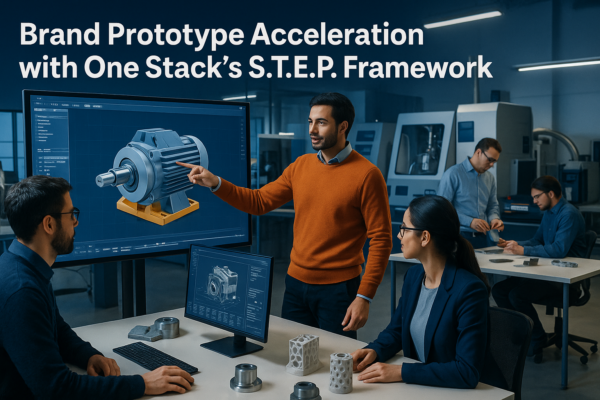
Implementing a Step-by-Step Framework
Turning a product vision into a factory-ready design requires a structured framework. The following five-step approach ensures efficiency and control throughout the process.
Step 1: Data Gathering and Research
Begin with comprehensive research—market trends, user needs, competitor analysis, and technical benchmarks. This data informs design decisions and ensures the final product meets both functional and commercial goals.
Step 2: Concept Design and Modeling
Translate insights into digital models. Use CAD and simulation tools to refine geometry, ergonomics, and performance. Keep manufacturability in mind, ensuring designs align with available materials and processes.
Step 3: Prototype Development
Create rapid prototypes to validate design assumptions. Testing physical samples helps verify dimensions, usability, and aesthetics. Feedback from these iterations informs necessary adjustments before mass production.
Step 4: Factory Alignment
Engage with manufacturing partners to confirm feasibility. Discuss tooling requirements, material sourcing, and quality controls. Egyptian factories within One Stack’s network, for instance, provide valuable insights into process optimization and cost efficiency.
Step 5: Final Design Freeze
Once prototypes are validated and factory inputs incorporated, finalize the design package. This includes detailed drawings, BOMs (Bills of Materials), and assembly guides ready for production.
Following this framework ensures each phase builds logically on the previous one, reducing friction and uncertainty.
Best Practices for Design Validation and Quality Control
Achieving speed doesn’t mean compromising quality. Rigorous validation ensures your factory-ready design performs reliably under real-world conditions.
Establish Clear Quality Benchmarks
Define measurable KPIs early—dimensional accuracy, surface finish, functional performance, and durability. Aligning these with factory quality systems ensures consistent outcomes.
Use Prototyping as a Learning Tool
Each prototype iteration should validate specific assumptions. Document findings, compare them against requirements, and feed insights back into design updates. This structured learning approach prevents costly errors later in production.
Integrate Feedback Loops
Continuous feedback between design, engineering, and manufacturing teams is critical. Real-time collaboration platforms allow instant updates and traceability, ensuring that no change goes unnoticed.
Strong validation processes protect both brand reputation and customer satisfaction—foundations of long-term success.
Leveraging Egyptian Manufacturing for Global Advantage
Egypt has rapidly emerged as a manufacturing hub offering world-class capabilities at competitive costs. For innovators seeking speed and reliability, local production presents a compelling advantage.
Cost Efficiency with Quality Standards
Egyptian factories combine affordable labor with advanced technology. Many facilities meet ISO and international certifications, ensuring products match global quality expectations while maintaining cost efficiency.
Strategic Geographic Access
Located at the crossroads of Africa, Europe, and the Middle East, Egypt offers logistical advantages for export-driven projects. Reduced shipping times and costs make it ideal for global brands seeking nearshore alternatives.
One Stack’s Integrated Network
Through its network of over 200 certified factories, One Stack provides entrepreneurs and companies a single-entry point into Egypt’s manufacturing ecosystem. This integration accelerates timelines and eliminates the complexity of managing multiple suppliers.
By leveraging Egypt’s growing industrial base, businesses gain both agility and competitive edge in global markets.
Conclusion
Transforming a product vision into a factory-ready design in weeks is no longer a distant goal—it’s an achievable standard. The key lies in structured processes, digital collaboration, and early engagement with manufacturing partners. When these elements align, speed and quality coexist seamlessly.
Whether you’re a startup founder or a supply chain manager, the ability to move from idea to production swiftly defines market leadership. Integrated partners like One Stack demonstrate how combining design expertise with manufacturing excellence can make this transition smooth, predictable, and cost-effective. Proudly made in Egypt, these solutions prove that innovation and efficiency can thrive together.
As you plan your next product, focus on clarity, speed, and control. With the right framework and partners, your vision can evolve into a tangible, factory-ready design faster than ever before.